
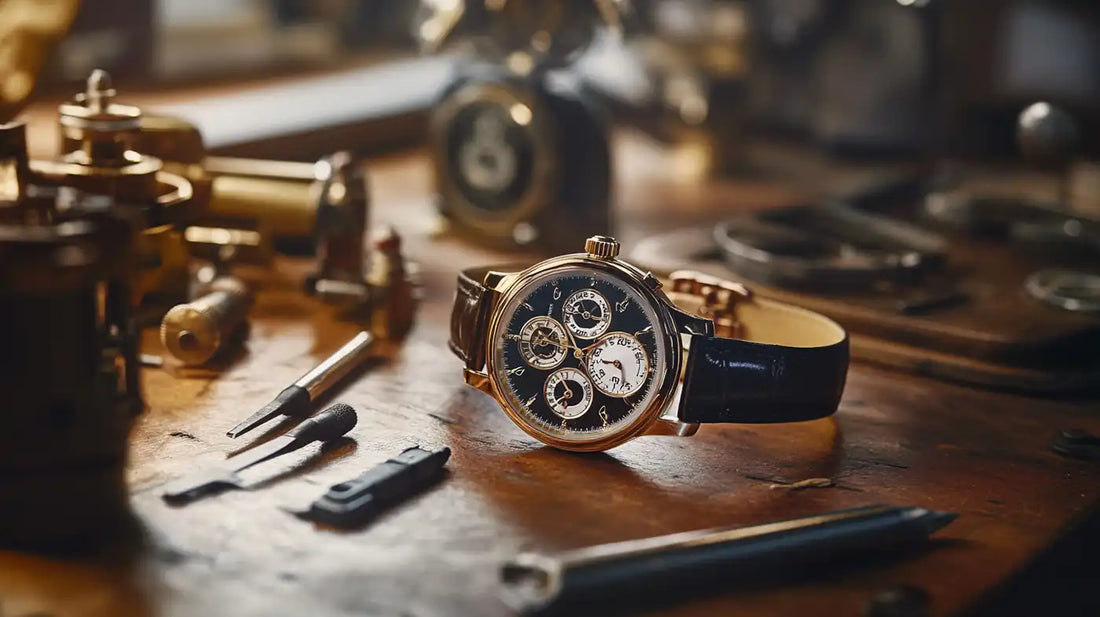
Automatic, Mechanical or Quartz Watches: Which Movement to Choose?
Reliability, precision, prestige… Each watch movement has its own particularities, but which one best meets your expectations?
When choosing a watch, design and materials are often the first selection criteria. But behind the appearance lies an essential element: the movement. There are three main types of watch movements – mechanical, automatic, and quartz – each offering unique advantages and characteristics. So, which one is right for you?
1. The Mechanical Movement: Watchmaking Craftsmanship in its Purest Tradition
Mechanical watches are the oldest and most prestigious. Their operation relies on a system of gears powered by a mainspring that must be wound manually.
Why choose a mechanical watch?
✅ Artisanal know-how : Each mechanical watch is the result of meticulous work, often carried out by hand by experienced watchmakers.
✅ A timeless object : Unlike quartz watches, a mechanical watch can work for decades with proper maintenance.
✅ Soul and charm : Watch enthusiasts appreciate the subtle ticking and smooth movement of the seconds hand.
The disadvantages
❌ Manual winding required : You must remember to wind your watch regularly, otherwise the time may stop.
❌ Less precision : A mechanical watch can lose or gain a few seconds per day, making it less reliable than a quartz model.
👉 Ideal for whom? Watch enthusiasts and those looking for an exceptional piece with an artisanal and historical dimension.
2. The Automatic Movement: The Balance Between Tradition and Practicality
Automatic watches work on the same principle as mechanical watches, but with one major difference: they do not require manual winding. An internal rotor, powered by the movements of the wrist, recharges the mainspring.
Why choose an automatic watch?
✅ No battery required : As long as you wear your watch regularly, it stays running thanks to its self-powered mechanism.
✅ A prestigious watchmaking brand : Like mechanical watches, automatic watches are often associated with major watchmaking houses.
✅ A smooth and elegant movement : The seconds hand glides with a characteristic fluidity, reinforcing the high-end look.
The disadvantages
❌ Necessary maintenance : It is recommended to have your automatic watch serviced every 5 to 10 years to ensure its proper functioning.
❌ A higher price : The complexity of the mechanism means that automatic watches generally cost more than a quartz watch.
👉 Ideal for whom? Those who want an elegant, sophisticated watch without the constraints of manual winding.

3. The Quartz Movement: Precision and Simplicity Above All
Quartz watches operate using a battery that sends an electrical impulse to a quartz crystal, generating an ultra-precise movement. This type of movement is the most widespread today.
Why choose a quartz watch?
✅ Unparalleled precision : A quartz watch typically loses only a few seconds per month, compared to several seconds per day for a mechanical model.
✅ No handling required : Unlike mechanical and automatic watches, there is no winding required, nor is it necessary to wear it regularly for it to work.
✅ A more affordable price : The simplicity of the mechanism allows us to offer reliable watches at accessible prices.
The disadvantages
❌ Less horological charm : A quartz watch does not possess the authenticity and nobility of a mechanical or automatic mechanism.
❌ Battery dependency : It needs to be replaced every 2 to 5 years depending on the model.
👉 Ideal for whom? Those looking for a practical, reliable and hassle-free watch with excellent value for money.
4. Which Movement Should You Choose According to Your Needs?
The choice of movement depends on several criteria: accuracy, maintenance, price and user experience.
If you're looking for a watch with authentic charm and strong craftsmanship , a mechanical movement is the obvious choice. It will appeal to lovers of traditional watchmaking and collectors, but it requires regular manual winding and is less accurate than a quartz model.
For those who want to enjoy the prestige of a mechanical watch without the daily winding , an automatic watch is an excellent compromise. Thanks to its internal rotor, it runs simply by being worn on the wrist. However, it requires periodic maintenance and is often more expensive.
Finally, if simplicity and precision are your priorities, then a quartz watch is for you. Very affordable, it requires no special maintenance other than changing the battery every few years. It's the perfect choice for those who want a reliable, accurate, and practical watch for everyday wear, even if it doesn't offer the same horological prestige as a mechanical or automatic model.
👉 Your choice will therefore depend on the balance between aesthetics, practicality and commitment to traditional watchmaking.
Conclusion: Which one suits you best?
The choice of movement depends primarily on your lifestyle and expectations:
- Are you passionate about traditional watchmaking and appreciate artisanal craftsmanship? Opt for a mechanical watch.
- Do you want a balance between tradition and practicality, without having to worry about winding? The automatic watch is ideal.
- Do you value precision and ease of use? A quartz watch will be your best ally.
💡 Question: Which watch movement best suits your lifestyle?


